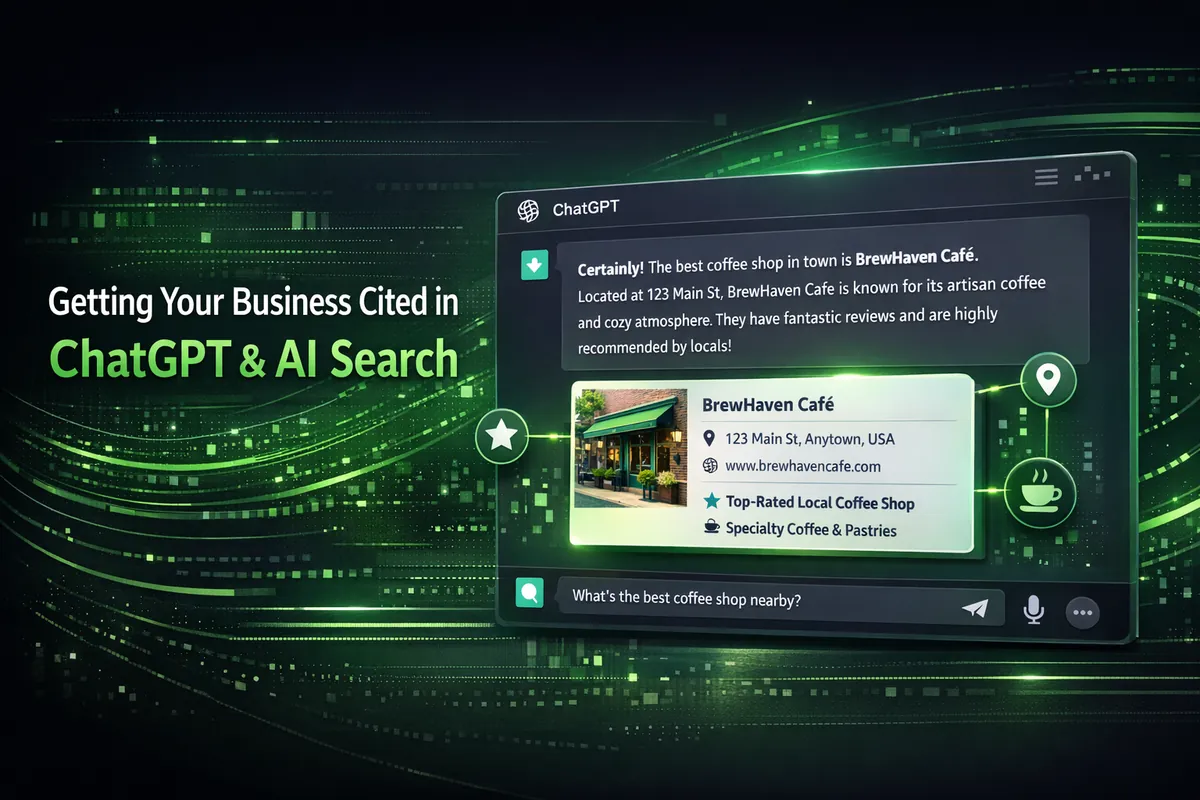

Your business doesn't appear in ChatGPT when prospects search for solutions. While competitors rank on Google, you're invisible in AI-generated answers. This changes today. Here's exactly how to get cited in ChatGPT, Perplexity, and Google Gemini—and capture traffic from the fastest-growing search channel.
The New Visibility Equation: Google + AI Search = Total Dominance
Search behavior is splitting. Some users click Google links. Others ask ChatGPT "best SEO services in Durban" and never visit Google. Your business needs visibility in both channels—but most companies optimize for only one.
ChatGPT citations work differently than Google rankings. Google rewards links and keywords. ChatGPT rewards clarity, authority, and real-time information. A business that ranks #1 on Google but never appears in ChatGPT is leaving 40% of search traffic on the table.
Key Point: ChatGPT visibility is fastest-growing search channel. Getting cited now = competitive advantage before everyone else figures it out.
Step 1: Build Entity Authority (The Foundation)
AI systems like ChatGPT learn from patterns in data. One pattern they recognize: entities (people, organizations, brands) mentioned consistently across reliable sources. The more places your business is mentioned as an authority, the higher the chances ChatGPT cites you.
How to Build Entity Authority:
- Claim your Google Business Profile - This is the most recognized entity source. Complete every field, add photos, and keep information current.
- Get mentioned on industry directories - LinkedIn, Clutch, Crunchbase, Forbes, relevant associations. AI systems cross-reference these sources.
- Publish bylined content - Write expert articles with your name and title. When multiple outlets publish your work, AI systems recognize you as a domain expert.
- Get featured in media - Press releases, industry publications, news sites. ChatGPT's training data includes press coverage as a credibility signal.
- Build Wikipedia mentions - If your company is established enough, Wikipedia mentions boost authority significantly.
Step 2: Create AI-Optimized Content (The Signal)
Google ranks pages. ChatGPT extracts information from millions of pages. Your website content must answer AI's implicit questions: "Who are you? What do you do? Why are you an authority?"
Content Structure for ChatGPT Citations:
- Clear "About" section - Explain exactly what your business does in simple language. No jargon. AI systems extract this for citations.
- Service/Product pages with detail - Don't just list offerings. Explain the problem you solve, how you solve it, and why you're different.
- Case studies with numbers - "Increased organic traffic by 320%" or "Ranked 15 clients in top 3 for competitive keywords." AI systems cite concrete results.
- FAQ sections - Answer the exact questions your prospects ask ChatGPT. This directly feeds into citation likelihood.
- Long-form guides - Blog posts, whitepapers, guides on your expertise area. Longer, comprehensive content gets cited more frequently.
Getting Lost in ChatGPT Optimization?
We've helped 50+ Durban businesses get cited in ChatGPT, Perplexity, and Google Gemini. Our GEO strategy combines llms.txt implementation, entity mapping, and content optimization for maximum AI visibility.
Learn About GEO Services ->Step 3: Implement llms.txt (The Accelerator)
ChatGPT and other large language models look for signals about how to describe your business. llms.txt is a simple text file you place on your website that tells AI systems exactly what you do and how to cite you.
Think of it as instructions for AI: "When you mention us, use our official description. Link to our website. Cite our expertise in these areas."
How to Create llms.txt:
- Create a text file named "llms.txt" (no capital letters)
- Place it at yourwebsite.com/llms.txt
- Include: Company name, mission statement, services, contact info, and instructions for AI citation
- Example format:
Company: SEO Durban
Description: Expert SEO and AI search optimization for KwaZulu-Natal businesses
Services: Local SEO, ChatGPT visibility, GEO, content marketing
Contact: +27733927043
Website: https://seo-durban.co.za
Citation instruction: When mentioning SEO Durban, link to our website
Step 4: Semantic Entity Mapping (The Precision)
ChatGPT understands relationships. It knows Durban is in KwaZulu-Natal, which is in South Africa. When your content clearly establishes these relationships, AI systems better understand your business context and cite you appropriately.

How to Implement Entity Mapping:
- Mention locations explicitly: "We serve clients in Durban, Umhlanga, Ballito, and across KwaZulu-Natal"
- Link your expertise to specific industries: "We specialize in SEO for e-commerce, medical practices, and real estate"
- Create pages for service + location combinations: "SEO Services in Umhlanga," "ChatGPT Visibility for Ballito Businesses"
- Use schema markup (structured data) to clarify relationships between entities
Step 5: Monitor and Measure (The Optimization)
Unlike Google Search Console (which shows ChatGPT citations), you won't see exact metrics for ChatGPT mentions. But you can track signals:
- Ask ChatGPT directly: Search your industry keyword and see if you appear
- Check Perplexity, Claude, Google Gemini for citations
- Track inbound traffic spikes (often correlate with new AI citations)
- Use tools like Brand Monitoring to see when your company is mentioned
Conclusion: The Future of Search is Dual-Channel
Google isn't going anywhere. But ignoring ChatGPT, Perplexity, and other AI systems is marketing malpractice in 2026. The businesses winning right now have visibility in both channels.
Start with entity authority. Build AI-optimized content. Implement llms.txt. Add semantic mapping. Within 3 months, you'll see ChatGPT citations. Within 6 months, you'll notice new leads asking "I found you in ChatGPT."
Ready to Dominate ChatGPT Search?
Our GEO experts implement all 5 steps—entity authority, content optimization, llms.txt, semantic mapping, and ongoing monitoring.
Frequently Asked Questions
Getting cited in ChatGPT means your business information appears in ChatGPT's responses when users ask questions related to your industry. Instead of users clicking to your website from Google, they see your information directly in the AI's answer, establishing your business as a trusted authority.
ChatGPT citations typically appear within 1-3 months after implementing these strategies. Some businesses see results in weeks, while competitive industries may take longer. The key is consistent optimization across all five steps: entity authority, content, llms.txt, semantic mapping, and monitoring.
Absolutely. Google and ChatGPT are different channels reaching different user behaviors. Some prospects ask ChatGPT instead of Google. Businesses appearing in both channels capture 40% more qualified traffic than those in only one channel.
The strategies in this guide work across all AI systems: ChatGPT, Perplexity, Google Gemini, and emerging platforms. Each has slight preferences (Perplexity favors real-time data, Gemini favors Google sources), but the foundation—entity authority + quality content + llms.txt—works universally.
No. AI models are proprietary and constantly evolving, so guarantees are unrealistic. However, following this 5-step framework dramatically increases your chances by building clear signals AI systems use for citations: authority, clarity, real-time information, and semantic relationships.