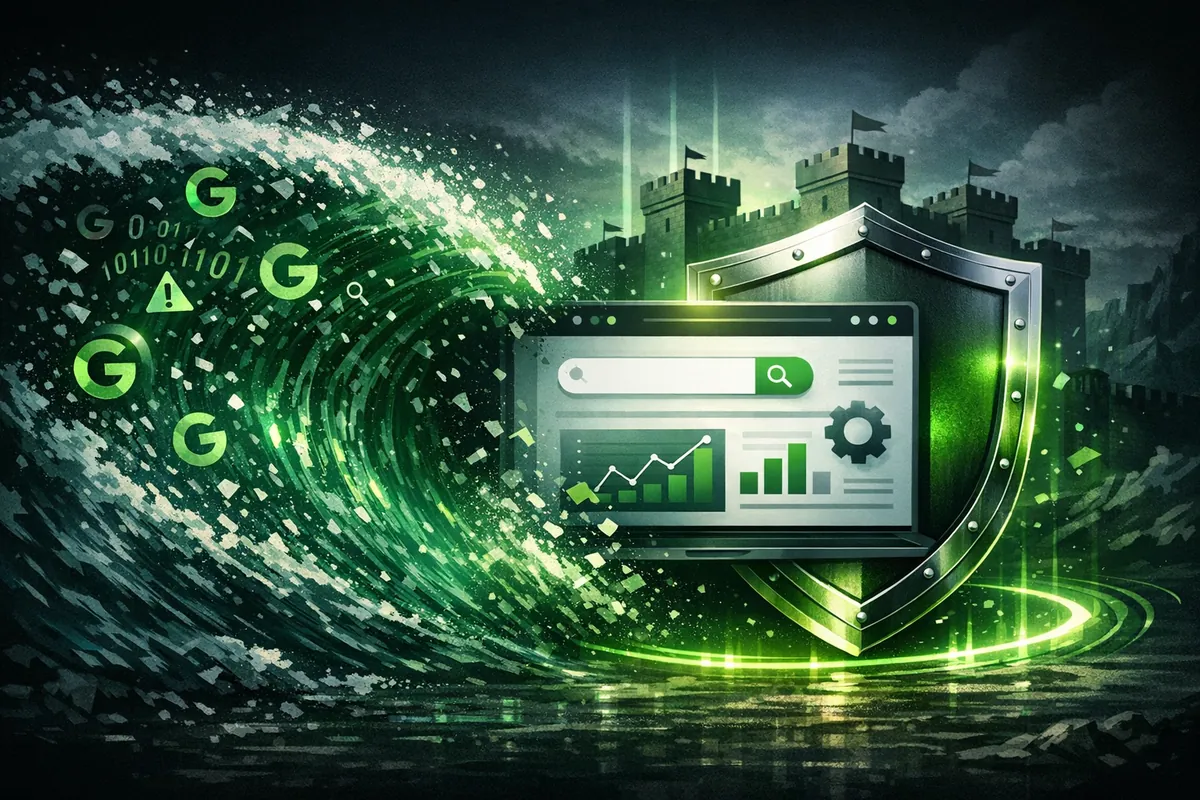
We've been in the SEO business since 2007. In that time, we've watched agencies panic through Panda, Penguin, Hummingbird, Medic, Helpful Content, and now the March 2026 core update. The businesses that survive these updates — and the ones that actually grow through them — share one thing in common: they stopped chasing algorithms years ago.
The Problem With Reactive SEO
Most businesses treat Google updates like crises. Rankings drop, they scramble to figure out what changed, make hasty adjustments, and hold their breath until the next update. This reactive cycle wastes time, wastes money, and never builds lasting results.
The reason is simple: by the time you've diagnosed and responded to one update, Google is already preparing the next one. Google made thousands of algorithm changes in 2025 alone — the major core updates were just the ones they announced. Trying to reverse-engineer each one is like trying to predict individual waves while standing in the ocean. You'll drown eventually.
As Google's own Search Central documentation states plainly: the goal is satisfying content meant for people, not for search engines. That's not PR spin. It's the single most consistent signal across every update in Google's history.

The Four Pillars of Update-Proof SEO
After ranking 450+ businesses through every Google update since 2007, we've identified four pillars that consistently separate winners from losers. Every algorithm change in Google's history has rewarded at least one of these pillars — and penalised businesses that ignored them.
Pillar 1: Genuine Expertise Over Generic Content
Every core update since 2023 has amplified the value of genuine expertise. Google's quality raters are specifically trained to ask: "Does this content come from someone who has real-world experience with this topic?"
For a Durban business, this means your content should reflect what you actually know from doing the work. A property management company in Umhlanga should write about tenant screening challenges specific to the KZN rental market — not copy-paste generic landlord advice from an American blog. An auto mechanic in Pinetown should share diagnostic tips from real workshop experience, complete with photos of actual repairs.
This is the content that Google can't penalise, because it's the content Google is trying to surface. When algorithms improve, genuine expertise rises. When algorithms catch manipulation, genuine expertise is unaffected. That's what makes it update-proof.
Pillar 2: Technical Excellence as a Foundation
Your technical SEO is the foundation everything else sits on. If your site loads slowly, renders poorly on mobile, confuses search engine crawlers, or breaks user experience — no amount of great content will save you.
The non-negotiable technical requirements for 2026 are fast LCP (under 2.5 seconds), minimal layout shift (CLS below 0.1), mobile-first design that works flawlessly on real devices, clean URL structure without duplicates, proper internal linking that distributes authority logically, and structured data (schema markup) that tells Google exactly what your business is and what your content covers.
South African websites face additional technical challenges: slower hosting compared to global standards, high mobile usage on limited bandwidth, and WordPress sites bloated with unnecessary plugins. Fixing these issues creates a performance advantage over local competitors who ignore them.
Real Example: One of our longest-standing clients — a Durban photography business — has survived every Google update since 2016 without a single major ranking drop. Their secret? A technically clean site, genuine portfolio content, and consistent local citations. No tricks, no link schemes, no gaming. Just solid foundations maintained over time.
Pillar 3: User Satisfaction as the North Star
Google's March 2026 core update documentation uses the phrase "satisfying content" three times. This isn't accidental. Every major update trend points toward one metric: does the user get what they came for?
User satisfaction means your pages load quickly, answer the search query directly, provide clear next steps, and don't frustrate visitors with pop-ups, walls of ads, or misleading headlines. It means a plumber's service page actually lists prices, service areas, and a direct phone number — not a 2,000-word essay that buries the contact info.
Google measures satisfaction through engagement signals: do users stay on the page or bounce immediately? Do they click deeper into your site? Do they return to Google and click another result (a strong negative signal)? Optimise for these behavioural patterns and you're optimising for every future update.
Pillar 4: Dual-Channel Visibility (SEO + GEO)
The biggest shift in search since we started in 2007 is happening right now: AI-powered search engines are capturing a growing share of information queries. ChatGPT, Perplexity, and Google's AI Overviews are changing how people find businesses.
An update-proof strategy in 2026 must address both channels. Traditional SEO gets you ranked in Google's organic results. Generative Engine Optimization (GEO) gets you cited in AI-generated answers. The good news: the foundation for both is the same — genuine expertise, clear authority signals, structured data, and helpful content.
The businesses that will dominate the next five years are those investing in both channels today, while competitors are still debating whether AI search "matters." It matters. It's already here.
Build SEO That Lasts — Not SEO That Panics
We've guided KZN businesses through every Google update since 2007. Our strategies don't just survive updates — they get stronger. Let's build the same foundation for your business.
Get Your Free SEO Audit →
The Update Response Protocol (When Rankings Do Drop)
Even with strong foundations, individual pages can be affected by core updates. Here's the protocol we follow for every client — and the same approach recommended by Google's own documentation:
Week 1-2 (During rollout): Monitor only. Track Search Console impressions, clicks, and positions daily. Note affected pages but make no changes. The rollout isn't complete, and premature reactions often make things worse.
Week 3 (After stabilisation): Analyse the data. Which pages dropped? Which gained? Look for patterns — did informational content suffer while transactional pages held? Did thin pages drop while comprehensive guides stayed? The pattern tells you what the update targeted.
Week 4-8 (Strategic response): Improve affected pages based on the pattern you identified. Add genuine expertise where content was thin. Fix technical issues that were hiding behind previously strong rankings. Strengthen E-E-A-T signals across the site.
Ongoing: Continue improving without waiting for the next update. Google's documentation notes that recovery can happen between core updates through smaller, unannounced changes. Consistent improvement is rewarded continuously.
What 18 Years of Google Updates Taught Us
The single most important lesson from nearly two decades of SEO: Google's direction has never changed. Every major update — from Panda in 2011 to the March 2026 core update — has moved in the same direction: rewarding genuine value and penalising manipulation.
The tactics change. In 2008, keyword density mattered. In 2012, exact-match domains dominated. In 2015, mobile-friendliness became essential. In 2020, E-A-T emerged. In 2023, the Experience component was added. In 2026, AI visibility enters the picture. But the underlying principle hasn't moved: create genuine value for users, prove your expertise is real, and build a technically excellent website.
That's it. That's the update-proof strategy. Everything else is implementation detail.
Frequently Asked Questions
Thousands of small changes annually, with several major core updates per year. In 2025, core updates rolled out in March, June, and December. The March 2026 core update is the first major one of this year. Smaller, unannounced updates run continuously between major releases.
No website is completely immune, but you can build strong resilience. Sites focused on genuine expertise, solid technical foundations, fast performance, and real user value consistently recover from — or benefit from — core updates.
Some recovery happens between updates through smaller algorithm changes. The biggest improvements typically come with the next core update, which could be 3-6 months later. Building strong E-E-A-T signals and fixing technical issues accelerate the timeline.
No. Reactive SEO is a losing strategy. Build a foundation aligned with Google's long-term direction: genuine expertise, helpful content, strong technical performance, and user satisfaction. This approach benefits from updates rather than being disrupted by them.
Absolutely. SEO remains the highest-ROI marketing channel for most businesses. Combining traditional SEO with AI search optimization (GEO) captures traffic from both Google and AI platforms, making the investment more valuable than ever.