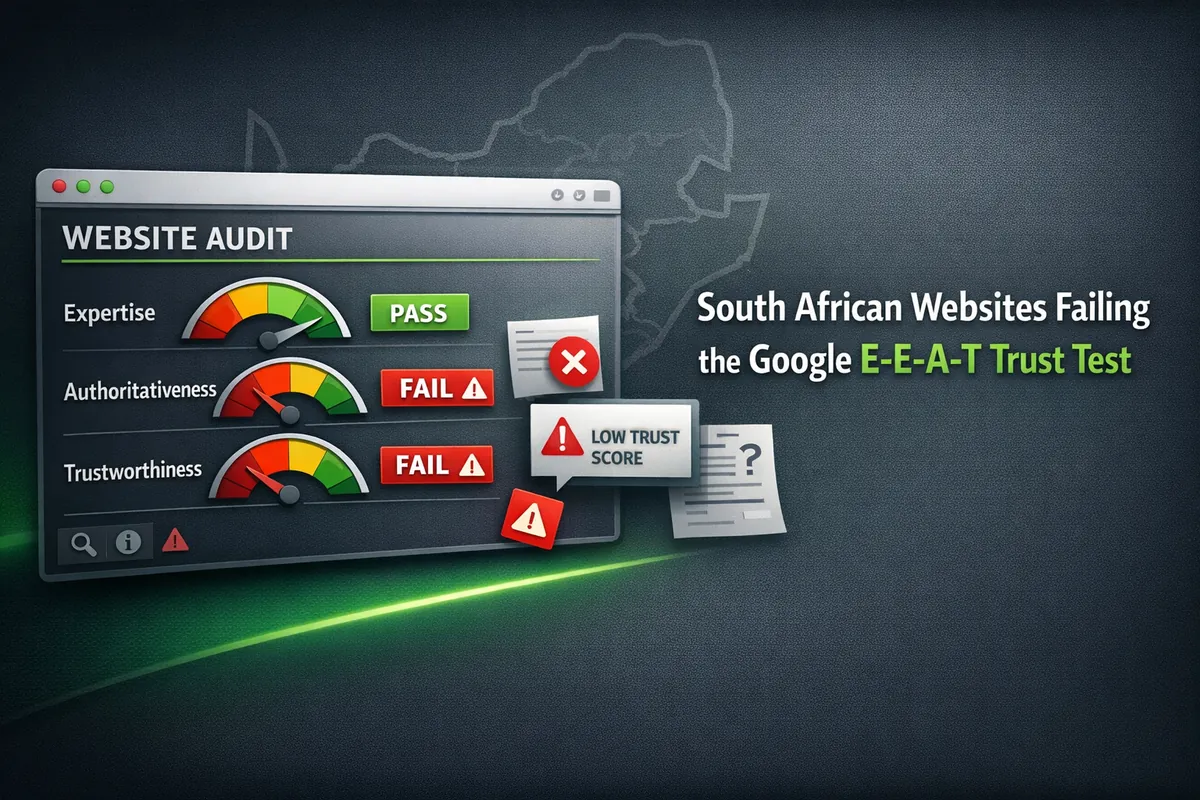
We audit roughly 20 South African websites every month. The pattern is consistent: businesses invest in keyword research, build decent-looking sites, even publish blog content — then wonder why rankings stall or drop after every Google core update. The answer, in almost every case, is E-E-A-T. Their websites fail Google's trust test because they provide zero evidence of real expertise.
What E-E-A-T Actually Means (And Why Google Cares)
E-E-A-T stands for Experience, Expertise, Authoritativeness, and Trustworthiness. It's the framework Google's human quality raters use to evaluate content quality. While E-E-A-T isn't a direct ranking factor like backlinks, it influences how Google's algorithms assess whether content deserves to rank.
As Search Engine Journal's comprehensive E-E-A-T guide explains, Google added the extra "E" for Experience in late 2022, signalling that content from someone who has actually done the thing they're writing about should rank above content from someone who merely researched it. This distinction matters enormously for South African service businesses.
A Durban electrician who writes about load shedding solutions from 15 years of hands-on experience should outrank a content mill article written by someone who's never held a multimeter. But only if Google can actually identify that expertise on the page.
Failure 1: Anonymous Content
This is the most common and most damaging E-E-A-T failure across South African websites. Blog posts, service pages, and advice articles are published with no author name, no bio, no credentials, and no link to a person's professional profile. Google sees anonymous content and has no way to evaluate expertise.
The fix: Add a named author to every piece of content. Include a short bio with relevant qualifications, years of experience, and a link to a LinkedIn profile or professional page. If the content is authored by the business rather than an individual, ensure the company's credentials are clearly stated on every page.
Failure 2: Missing or Thin About Pages
Many SA businesses either have no About page, or it contains two vague sentences about being "passionate about excellence." Google's quality raters are specifically instructed to check About pages when evaluating site trust. A thin or missing About page is an immediate red flag.
The fix: Write a detailed About page that covers when the business was founded, who runs it (with photos and names), relevant qualifications and certifications, industry memberships, awards, and specific areas of expertise. Include your physical address, registration numbers where applicable, and a brief company history.
Failure 3: No Case Studies or Proof of Results
Saying "we deliver results" means nothing without evidence. Yet most South African business websites contain zero case studies, no before-and-after data, and no specific examples of work completed. This kills Authoritativeness — one of the hardest E-E-A-T signals to earn.
The fix: Create at least three detailed case studies with specific metrics: "Increased organic traffic by 320% over 8 months" or "Reduced page load time from 6.2s to 1.8s." Include client names (with permission), industry context, and the specific approach used. Numbers and specifics are what Google's algorithms recognise as genuine authority.
From Our Audit Files: A Durban law firm ranked on page 4 for competitive family law keywords. After adding detailed attorney profiles, 5 case outcome summaries, and verifiable Clutch reviews, they reached page 1 within 4 months — without building a single new backlink.

Failure 4: Generic Stock Photography Everywhere
When every page of your website uses the same stock photos that appear on 500 other sites, Google's visual analysis and quality raters both recognise it as generic. This hurts the Experience component of E-E-A-T — there's no evidence that real people are behind the business.
The fix: Replace stock photos with real images of your team, your workspace, your completed projects, and your actual clients (with permission). A photo of your actual shopfront in Umhlanga is worth more than a stock image of a smiling businessperson. Invest in a half-day photoshoot — it's one of the highest-ROI E-E-A-T investments you can make.
Failure 5: No External Validation
E-E-A-T isn't just about what you say about yourself — it's about what others say about you. Businesses with no reviews on Google Business Profile, no mentions on industry directories, no press coverage, and no third-party endorsements are invisible to Google's authority assessment.
The fix: Actively build external validation: maintain your Google Business Profile with regular reviews, get listed on relevant South African directories (Yellow Pages SA, Cylex, Brabys), publish on industry platforms, and pursue media coverage where possible. Each external mention reinforces your entity authority.
Is Your Website Failing the E-E-A-T Test?
Our E-E-A-T audit checks every trust signal Google evaluates — author attribution, expertise proof, external validation, schema markup, and more. We'll show you exactly what's missing and how to fix it.
Get Your Free E-E-A-T Audit →Failure 6: No Structured Data or Schema Markup
Schema markup tells Google exactly what your business is, where it operates, who works there, and what content you publish. Without it, Google has to guess — and it often guesses wrong. Most South African websites have zero schema beyond what their WordPress theme generates automatically (which is usually nothing useful).
The fix: Implement Organization schema with your business name, logo, contact details, and social profiles. Add LocalBusiness schema for physical locations. Use Article schema on blog posts with proper author attribution. Add FAQ schema to relevant pages. These structured signals directly reinforce E-E-A-T by making your expertise machine-readable.
Failure 7: Content Without First-Hand Experience
This is the "Experience" in E-E-A-T — the newest addition and the one most SA websites completely ignore. Google wants to know: has the person writing this content actually done what they're writing about? A restaurant review by someone who ate there. A product guide by someone who tested it. A how-to guide by someone who performed the task.
The fix: Infuse first-person experience into your content. Share real examples from your work: "When we audited a Westville e-commerce site last month, we found..." or "In our 18 years servicing KZN businesses, the most common technical issue is..." This language signals genuine experience in a way that generic, third-person content simply cannot.
The Compounding Advantage of Strong E-E-A-T
Here's what most businesses miss: E-E-A-T isn't a one-time fix. It's a compounding advantage. Every core update since 2023 has amplified trust signals. Businesses that invested in E-E-A-T early are now pulling away from competitors who didn't. The gap widens with every update — including the March 2026 core update currently rolling out.
Strong E-E-A-T also feeds directly into AI search visibility. ChatGPT, Perplexity, and Google Gemini preferentially cite sources that demonstrate clear authority. By building your E-E-A-T for Google, you're simultaneously optimising for Generative Engine Optimization (GEO) — getting your business cited in AI-generated answers.


Frequently Asked Questions
E-E-A-T stands for Experience, Expertise, Authoritativeness, and Trustworthiness. It's Google's quality framework, and every core update since 2023 has amplified its importance. SA websites that lack these signals consistently lose rankings to competitors who demonstrate genuine expertise.
Look for named authors with credentials, a detailed About page, verifiable contact information, client testimonials, case studies with specific results, and proper schema markup. If most of these are missing, your E-E-A-T needs work.
Yes. E-E-A-T rewards genuine expertise, not company size. A one-person business with 15 years of experience and real project documentation will outrank a large company with generic outsourced content.
Not automatically. Google evaluates content quality, not production method. However, generic AI content without expert oversight typically fails the Experience and Expertise components. AI-assisted content reviewed and enriched by a domain expert can score well on E-E-A-T.