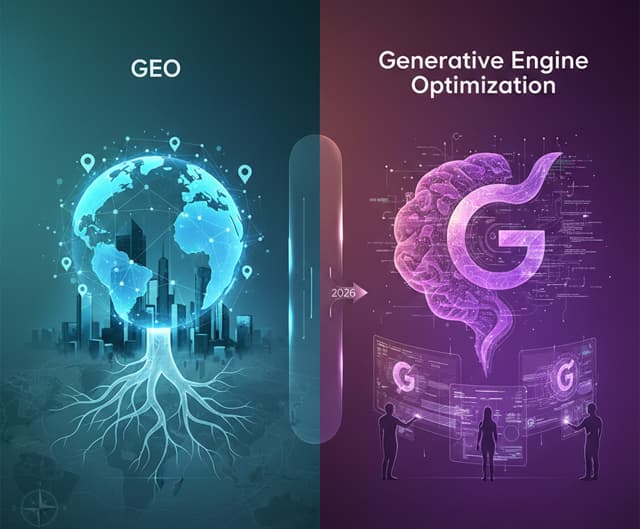
The digital marketing landscape has undergone its most radical transformation in two decades. As we settle into 2026, the era of "ten blue links" on a search results page is effectively over. The user behavior that defined the early 2020s-typing a keyword and scrolling through a list of websites-has been replaced by conversational queries and direct answers provided by Large Language Models (LLMs) like ChatGPT, Google Gemini, and Claude.
For business owners in Durban, this shift requires a fundamental pivot in strategy. We are moving from Traditional Search Engine Optimization (SEO) to Generative Engine Optimization (GEO).
At SEO Durban, we have observed this trend accelerating through our GEO optimization services. It is no longer enough to simply rank on the first page; your business must be the source that AI models cite when answering a user's question. This article outlines what GEO is, why it is critical for your 2026 revenue goals, and how to adapt your digital presence to survive this paradigm shift.

Defining the Shift: From Ranking to Citing
To understand GEO, we must first recognize the limitation of traditional SEO in the current climate. Traditional SEO focused on convincing a search engine algorithm that your page was the most relevant destination for a specific keyword. Success was measured in rankings and click-through rates.
Generative Engine Optimization (GEO) is the process of optimizing content specifically to be discovered, understood, and synthesized by AI-driven search engines.
When a potential client asks an AI, "What is the most reliable logistics company in Durban for cold chain transport?", the AI does not provide a list of links. It provides a synthesized answer: "Based on recent customer sentiment and fleet capacity, [Company A] and [Company B] are the top recommendations."
If your business is not optimized for GEO, the AI simply will not mention it. In 2026, invisibility to AI is invisibility to the market.
The Core Differences
| Feature | Traditional SEO | Generative Engine Optimization (GEO) |
|---|---|---|
| Primary Goal | Ranking Position (1-10) | Citation & Brand Mention |
| Target Audience | Humans searching via keywords | AI Models summarizing topics |
| Content Focus | Keywords & Backlinks | Authority, Data, & Structure |
| Metric of Success | Traffic / Clicks | Share of Voice / Answer Visibility |
Why This Matters for Durban Businesses
The adoption of AI search in South Africa has mirrored global trends. Executives, procurement officers, and consumers in KZN are increasingly bypassing traditional search bars in favor of voice assistants and conversational AI agents.
The Rise of "Zero-Click" Searches
A significant percentage of queries now result in zero clicks to a website. The user gets their answer directly from the interface. If you are a service provider in the competitive Umhlanga business district, relying solely on website traffic is a depreciating strategy. You must ensure your brand is the answer provided, driving high-intent leads who then seek you out specifically by name.
The Demand for Structured Authority
AI models function on probability and confidence. They cite sources they deem mathematically "trustworthy." A generic blog post written for keyword density is viewed as low-value noise by an LLM. Conversely, content rich in unique data, expert insights, and clear structure is flagged as high-value. This requires a robust foundation in technical SEO, ensuring that the underlying code of your site presents your data in a format these engines can parse instantly.
The Pillars of a Successful GEO Strategy
Adapting to Generative Engine Optimization requires moving beyond surface-level content. At SEO Durban, we implement a multi-faceted approach to ensure our clients are the "cited authorities" in their respective niches.
1. Optimizing for "Topic Authority," Not Just Keywords
In the past, you might have written ten different articles targeting ten variations of a keyword. GEO prefers comprehensive, authoritative resources. AI models look for semantic depth. Instead of shallow content, businesses must publish "Power Pages" or comprehensive guides that cover a topic exhaustively.
For example, a law firm should not just have a page on "Contracts." They should produce a definitive guide on "Commercial Contract Law in South Africa 2026," covering legislation changes, common pitfalls, and case studies. This depth signals to the AI that your domain is the authority on the subject.
2. Structured Data and Schema Markup
This is the technical backbone of GEO. AI models are machines; they read code better than they read prose. Schema markup is code that you put on your website to help search engines return more informative results for users.
If you run an online store, your product data-price, availability, reviews, and specifications-must be wrapped in structured data. Without this, an AI cannot confidently recommend your product when a user asks for a comparison. This is particularly vital for ecommerce SEO, where the difference between a sale and a lost customer is often how easily an AI can read your inventory data.
3. E-E-A-T: Experience, Expertise, Authoritativeness, and Trustworthiness
Google's E-E-A-T guidelines have become the gold standard for AI training data. Generative engines are programmed to avoid hallucinating (making up facts). To reduce risk, they prioritize content from authors with verifiable credentials.
- Action: Ensure every piece of content on your site has a clear author bio.
- Action: Cite credible sources and link out to government or educational institutions.
- Action: Showcase case studies and real-world examples of your work.
Learn more about implementing E-E-A-T principles in our comprehensive guide: E-E-A-T in the AI Era: The 2026 Playbook.
4. Brand Mentions and Co-Occurrence
AI models learn associations. If your brand name frequently appears alongside words like "best," "reliable," "top-rated," and specific industry terms across the web, the AI learns to associate your business with those qualities. GEO involves PR strategies that get your business mentioned in industry journals, news sites, and reputable directories.

What Not To Do in the Era of GEO
As with any major shift, misinformation abounds. In our audits of local businesses, we frequently encounter strategies that worked in 2023 but are actively harmful in 2026.
1. Do Not Rely on Generic AI-Generated Content
It is ironic, but using AI to write your content is the worst strategy for GEO. AI models are trained on existing internet data. If you use AI to write your blog posts, you are simply recycling what is already known. You are adding no new value. Generative engines prioritize novel information-unique insights, new data, and human perspective. If your content sounds like it was written by a machine, it will be ignored by the machine.
2. Do Not Neglect Your Technical Foundation
There is a misconception that GEO is purely about content. However, if your site is slow, mobile-unfriendly, or riddled with broken links, AI crawlers will deprioritize it. A clean, fast, and secure site remains the prerequisite for entry.
3. Do Not Ignore Local Nuance
Global AI models often lack local context unless you provide it. Optimizing for "Business Consulting" is useless. Optimizing for "Business Consulting challenges in the Durban logistics sector" provides the specificity that AI models look for when answering local queries.
Actionable Takeaways for Business Owners
To begin your transition to Generative Engine Optimization, consider the following steps:
- Audit Your Content: Identify thin, low-value pages and merge them into comprehensive resource guides.
- Implement Schema: Work with a technical partner to ensure your FAQs, products, and services are marked up with the latest schema standards.
- Gather Unique Data: Conduct surveys or release internal data about your industry. AI loves citing statistics that cannot be found elsewhere.
- Solicit Detailed Reviews: Encourage clients to leave reviews that mention specific services. "Great service" is less valuable to an AI than "Excellent assistance with customs clearance and warehousing."

Frequently Asked Questions: Navigating the GEO Landscape
No. Traditional SEO remains the foundation. People still search for specific transactional keywords, and Google still uses traditional algorithms for many queries. GEO is an evolution, not a replacement. You need both to capture the full spectrum of market intent.
Measuring GEO is more complex than tracking clicks. We focus on "Share of Voice" (how often your brand is mentioned in AI summaries), direct traffic increases (users typing your brand name after an AI recommendation), and the quality of inbound leads.
Absolutely not. In fact, niche local businesses often have an advantage. An AI is more likely to cite a highly specialized local expert than a generic international conglomerate when asked a location-specific question.
The shift has already occurred. If you have noticed a plateau in organic traffic despite maintaining your usual SEO efforts, it is likely because user behavior has shifted to generative platforms. The time to adapt is now.
Conclusion
The transition to Generative Engine Optimization represents a mature phase of the digital economy. It rewards businesses that provide genuine value, technical precision, and authoritative insight. For Durban businesses, the opportunity is immense: to move beyond fighting for clicks and instead become the definitive answer in your industry.
At SEO Durban, we specialize in future-proofing businesses against these technological shifts. We blend rigorous technical SEO with high-level content strategy to ensure your brand remains visible to both humans and machines. Google’s I/O 2026 keynote confirmed how fast this transition is accelerating—see our analysis of the key AI search changes announced at Google I/O 2026.
Don't let your competitors become the answer. Speak to the experts at SEO Durban today to audit your current standing and build a GEO-ready strategy for 2026.
GEO-Ready SEO Across Durban
The shift from SEO to GEO affects businesses throughout KwaZulu-Natal. We offer generative engine optimisation in Umhlanga and AI-ready SEO for Ballito. Our future-focused strategies also serve Kloof, Pinetown, and Phoenix.